|
I am a Founding Research Engineer at Paper Instruments (formerly The LLM Data Company), where I work on LLM post-training and reinforcement learning. My recent work focuses on making RL for LLMs stable and predictable at scale: training–inference mismatch, off-policy and asynchronous RL, and scaling RL on large agentic models, including non-verifiable tasks with rubric-based rewards. Before this, I worked on robot learning and autonomous driving perception. I received my MScAC from the University of Toronto and my Bachelor of Computer Science from Beijing University of Posts and Telecommunications (BUPT). Gmail | Google Scholar | Github | LinkedIn |

|
|
|

|
Shu Liu*, Qi Fang*, Shubham Agarwal Blog post, 2026 blog We test score centering with and without importance sampling and KL penalties while varying staleness, batch size, and learning rate, to find when centering alone is enough for asynchronous RL. |

|
Paper Instruments Paper Instruments Blog, 2026 blog An agentic model for professional knowledge work, built by large-scale RL on GLM-5.3 Flash with synthesized non-verifiable tasks and rubric rewards. It improves on all six knowledge-work benchmarks we evaluate while generating fewer tokens. |

|
Daanish Khazi, Gavin Bains, Joey Besgen, Qi Fang Paper Instruments Blog, 2026 blog On 1,158 physician-labeled rubric criteria, gpt-oss-120b nearly matches Opus 4.7 as a judge (0.894 vs. 0.899 F1) at about 100× lower cost, and grading the full rubric in one call beats per-criterion grading for every model tested. |

|
Qi Fang, Daanish Khazi, Gavin Bains, Joey Besgen, Malthe Have Musaeus, Rohit Rastogi Paper Instruments Blog, 2026 blog We scale medical RL to Kimi K2.5 without simulated environments, improving clinical answers, and document the tool-calling instabilities that appear under heavy long-context load. |

|
Paper Instruments Paper Instruments Blog, 2026 blog A medical reasoning model trained with RL for clinical accuracy, less sycophancy, and concise answers. State of the art on HealthBench Hard (46.6%). |
|
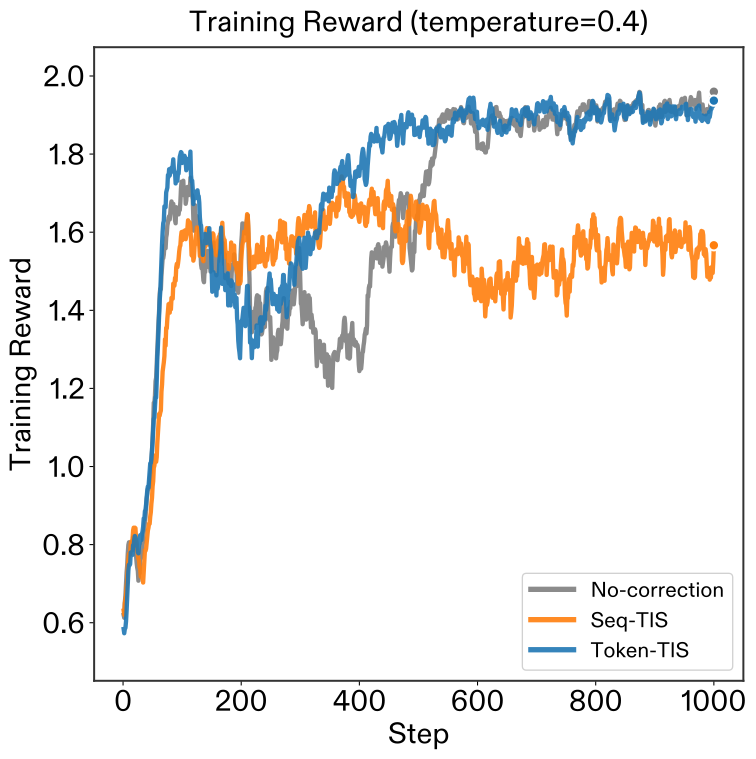
Qi Fang*, Daanish Khazi* Paper Instruments Blog, 2025 blog Separate inference and training engines produce policy mismatch even with identical weights, and non-default sampling settings make it worse. Token-level importance correction with default sampling is the most robust fix; sequence-level IS becomes unstable on long responses. |

|
Yiming Li*, Qi Fang*, Jiamu Bai, Siheng Chen, Felix Juefei-Xu, Chen Feng International Conference on Computer Vision (ICCV), 2023 arXiv / code We proposed a novel probability-guaranteed sampling method inspired by RANSAC to achieve a trust-worthy group of benign agents, outperforming adversarial training Method by 73%. |

|
Xinhao Liu*, Moonjun Gong*, Qi Fang, Haoyu Xie, Yiming Li, Hang Zhao, Chen Feng IEEE/RSJ International Conference on Intelligent Robots and Systems (IROS) , 2024 arXiv / project / code / data We proposed a new LiDAR perception task, Occupancy Completion and Forecasting (OCF), combining scene completion and forecasting in autonomous driving, and evaluates it using the newly curated OCFBench dataset. |